Web2 vs Web3: The Evolution of the Internet — A Complete Guide
Web2 vs Web3: The Evolution of the Internet — A Complete Guide
Introduction
The internet is evolving, and we’re witnessing a fundamental shift from Web2 to Web3. This transformation isn’t just about new technology — it’s about reimagining how we interact, own data, and conduct business online. In this comprehensive guide, we’ll explore the differences between Web2 and Web3, their unique characteristics, and what this means for the future of the digital world.
What is Web2?
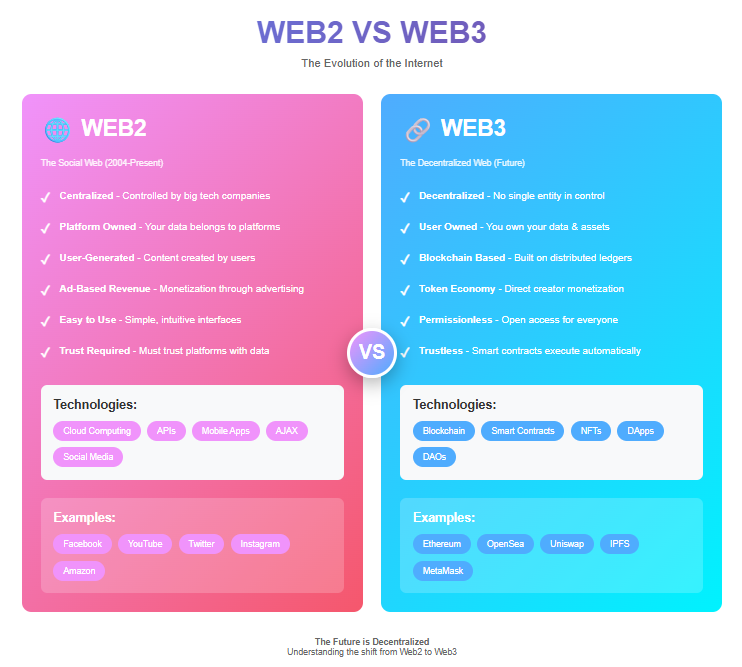
Web2, also known as the “Social Web,” represents the current phase of the internet that most of us use daily. It emerged in the early 2000s and brought interactive, user-generated content to the forefront.
Key Characteristics of Web2:
Centralized Control: Large corporations like Google, Facebook, Amazon, and Twitter control most platforms. They own the servers, data, and infrastructure.
User-Generated Content: Unlike Web1 (read-only web), Web2 allows users to create and share content. Think YouTube videos, Instagram posts, and Twitter threads.
Data Ownership: While you create content, platforms own your data. They can use it for advertising, sell it to third parties, or even restrict your access.
Monetization Models: Revenue primarily comes from advertising. Your attention and data are the products being sold.
Ease of Use: Web2 platforms are incredibly user-friendly with intuitive interfaces that require no technical knowledge.
Examples of Web2 Platforms:
- Social Media: Facebook, Instagram, Twitter, TikTok
- Content Platforms: YouTube, Medium, WordPress
- E-commerce: Amazon, eBay, Shopify
- Communication: WhatsApp, Telegram, Zoom
Advantages of Web2:
- Easy to use and accessible
- Rich user experience with multimedia content
- Strong network effects and large communities
- Fast development and innovation
- Free services for users
Disadvantages of Web2:
- Privacy concerns and data breaches
- Centralized censorship and control
- Platform dependency and lock-in
- Lack of data ownership
- Revenue doesn’t benefit content creators fairly
What is Web3?
Web3, or the “Decentralized Web,” represents the next evolution of the internet. Built on blockchain technology, it promises to return power and ownership to users.
Key Characteristics of Web3:
Decentralization: No single entity controls the network. Power is distributed among users through blockchain technology.
User Ownership: You truly own your data, digital assets, and identity. This is managed through cryptocurrency wallets and NFTs.
Transparency: All transactions and operations are recorded on public blockchains, making them verifiable and auditable.
Permissionless: Anyone can participate without approval from gatekeepers. No company can ban you or restrict access.
Trustless: Smart contracts execute automatically based on code, eliminating the need to trust intermediaries.
Core Technologies of Web3:
Blockchain: Distributed ledger technology that records all transactions across a network of computers.
Cryptocurrencies: Digital currencies like Bitcoin and Ethereum that enable peer-to-peer transactions without banks.
Smart Contracts: Self-executing contracts with terms written directly into code, running on blockchains.
NFTs (Non-Fungible Tokens): Unique digital assets that prove ownership of digital or physical items.
DApps (Decentralized Applications): Applications that run on blockchain networks rather than centralized servers.
DAOs (Decentralized Autonomous Organizations): Organizations governed by code and community voting rather than traditional hierarchies.
Examples of Web3 Platforms:
- DeFi: Uniswap, Aave, Compound
- NFT Marketplaces: OpenSea, Rarible
- Social Networks: Lens Protocol, Farcaster
- Storage: IPFS, Filecoin, Arweave
- Gaming: Axie Infinity, Decentraland
Advantages of Web3:
- True data ownership and privacy
- Resistance to censorship
- Transparent and verifiable systems
- Direct monetization for creators
- Interoperability between platforms
- Enhanced security through decentralization
Disadvantages of Web3:
- Steep learning curve for average users
- Slower transaction speeds
- Higher costs (gas fees)
- Environmental concerns (energy consumption)
- Regulatory uncertainty
- Scams and security risks for inexperienced users
Web2 vs Web3: Direct Comparison
Ownership
Web2: Platforms own your data, content, and digital assets Web3: You own your data, content, and digital assets through cryptographic keys
Control
Web2: Centralized control by corporations Web3: Distributed control by community and users
Monetization
Web2: Platforms profit from your data and content Web3: Creators earn directly through tokens and cryptocurrencies
Identity
Web2: Separate accounts for each platform Web3: One decentralized identity across all applications
Trust
Web2: Must trust platforms with your data Web3: Trustless systems verified by code and blockchain
Accessibility
Web2: User-friendly, easy to adopt Web3: Technical, requires understanding of crypto wallets and blockchain
Speed
Web2: Fast, optimized centralized servers Web3: Slower due to blockchain consensus mechanisms
Cost
Web2: Free for users (you pay with your data) Web3: Transaction fees (gas fees) for blockchain operations
Real-World Use Cases
Web3 in Finance (DeFi)
Decentralized finance allows you to lend, borrow, trade, and earn interest without banks. Platforms like Uniswap enable peer-to-peer trading, while Aave lets you earn interest on crypto deposits.
Web3 in Gaming
Play-to-earn games reward players with cryptocurrency and NFTs they truly own. Games like Axie Infinity have created entire economies where players earn real income.
Web3 in Content Creation
Platforms like Mirror and Lens Protocol allow creators to own their content and audience relationships, earning directly through tokens and NFTs without platform middlemen.
Web3 in Supply Chain
Companies use blockchain to track products from origin to consumer, ensuring authenticity and transparency in industries from luxury goods to food safety.
Challenges Facing Web3 Adoption
Scalability
Current blockchain networks struggle to handle the transaction volume of Web2 platforms. Solutions like Layer 2 networks and sharding are being developed.
User Experience
Web3 requires managing private keys, understanding gas fees, and navigating complex interfaces. Mass adoption needs better UX design.
Regulation
Governments worldwide are still figuring out how to regulate cryptocurrencies and decentralized applications, creating uncertainty.
Energy Consumption
Proof-of-work blockchains consume significant energy. However, many networks are transitioning to more efficient proof-of-stake systems.
Security Risks
While blockchain is secure, user errors (like losing private keys) and smart contract vulnerabilities can lead to significant losses.
The Future: Web2.5?
Many experts believe we’ll see a hybrid model — Web2.5 — where centralized and decentralized systems coexist. Companies are already experimenting with blockchain integration while maintaining familiar user interfaces.
Examples of Web2.5:
- Twitter (X) exploring decentralized features
- Reddit’s blockchain-based community points
- Instagram testing NFT integration
- Meta’s investment in metaverse and blockchain
How to Get Started with Web3
Step 1: Learn the Basics
Understand blockchain technology, cryptocurrencies, and how decentralized networks function.
Step 2: Set Up a Wallet
Create a cryptocurrency wallet like MetaMask or Trust Wallet to store digital assets and interact with DApps.
Step 3: Get Some Cryptocurrency
Purchase cryptocurrency from exchanges like Coinbase or Binance to pay for transaction fees.
Step 4: Explore DApps
Start with user-friendly applications like NFT marketplaces (OpenSea) or DeFi platforms with good tutorials.
Step 5: Join Communities
Participate in Discord servers, follow Web3 projects on Twitter, and engage with DAO communities.
Step 6: Stay Secure
Never share your private keys, use hardware wallets for large amounts, and be cautious of scams.
Conclusion
Web2 and Web3 represent different philosophies about how the internet should function. Web2 prioritized ease of use and network effects, creating powerful platforms that connect billions of people. Web3 prioritizes ownership, privacy, and decentralization, aiming to create a more equitable digital future.
The transition from Web2 to Web3 won’t happen overnight. It’s more likely we’ll see a gradual evolution where the best aspects of both worlds combine. For users, this means more choices: stick with familiar Web2 platforms, dive into Web3 innovation, or use hybrid solutions that offer the best of both.
Understanding both systems is crucial as we navigate this digital transformation. Whether you’re a developer, creator, investor, or everyday internet user, the Web3 revolution will impact how you interact with the digital world.
The question isn’t whether Web3 will replace Web2, but rather how these systems will coexist and complement each other to create a better internet for everyone.
What are your thoughts on Web2 vs Web3? Are you excited about decentralization, or do you prefer the simplicity of current platforms? Share your opinions in the comments below!
Keywords: Web2, Web3, blockchain, cryptocurrency, decentralization, NFT, DeFi, smart contracts, digital ownership, internet evolution